Pure Peptides Australia
GHK-Cu – Research Peptide | Pure Peptides Australia
GHK-Cu – Research Peptide | Pure Peptides Australia
Not for human, veterinary, diagnostic, or therapeutic use.
Dermal research compound
GHK-Cu (50mg and 100mg): Copper Tripeptide for Skin, Collagen and Repair Research
GHK-Cu is the naturally occurring copper complex of the tripeptide glycyl-L-histidyl-L-lysine, first isolated from human plasma by Loren Pickart in 1973. Its concentration in plasma falls from roughly 200ng/mL at age 20 to 80ng/mL by 60, and that decline is the reason it sits at the centre of skin, collagen, hair-follicle and wound-remodelling research. It is the most searched copper peptide in Australia. Searched as ghk-cu australia, ghk cu, ghkcu, copper peptide australia and copper tripeptide-1.
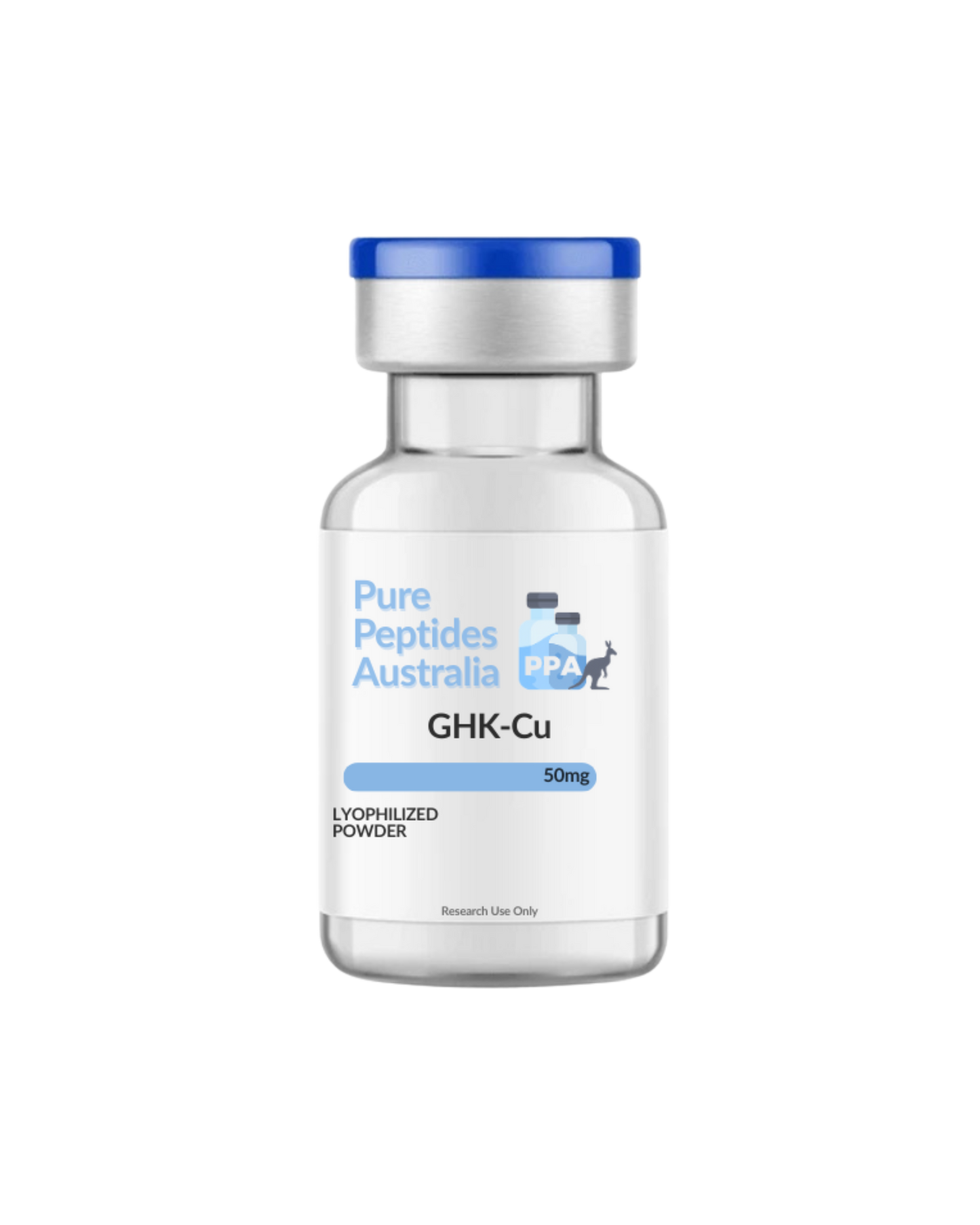
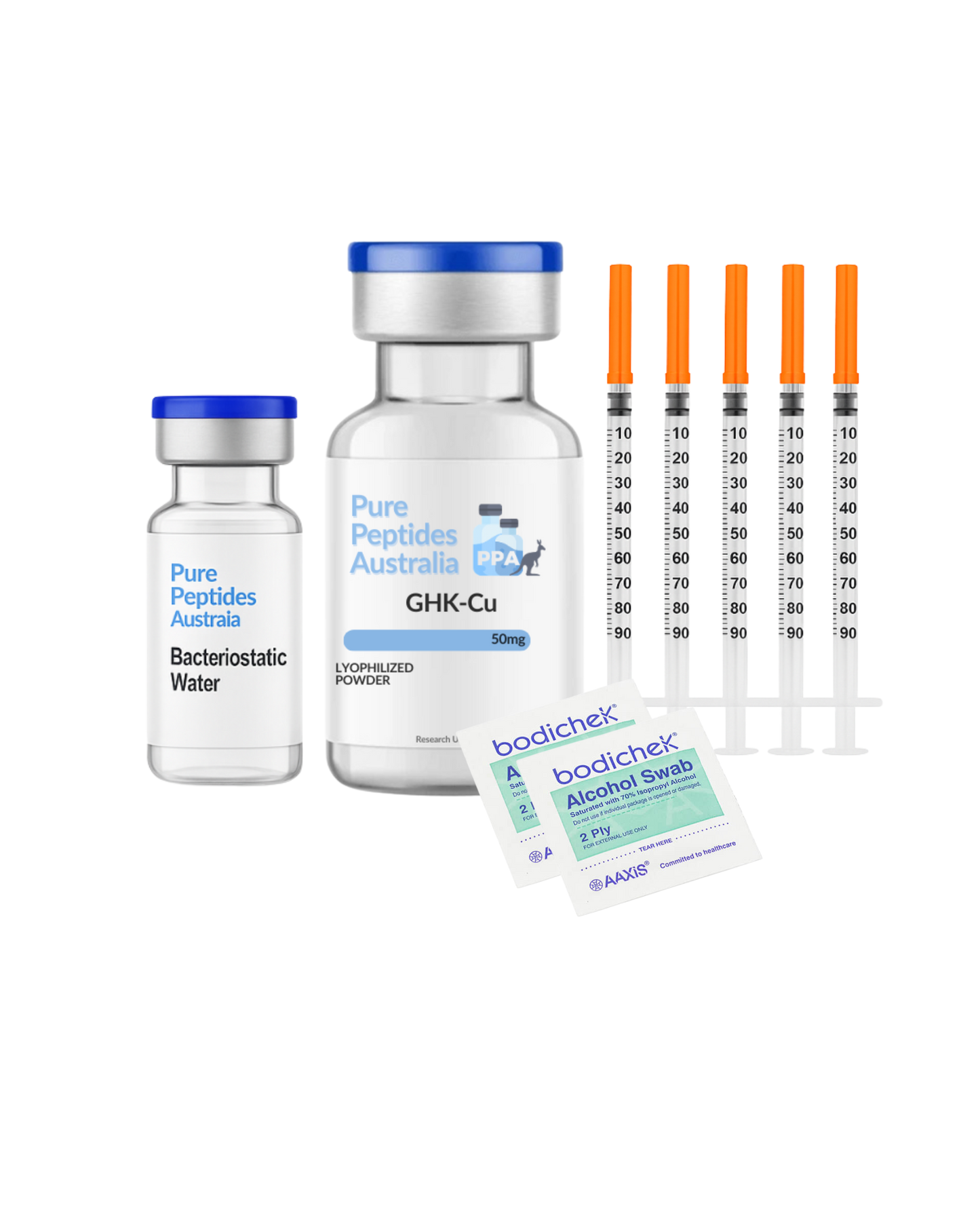
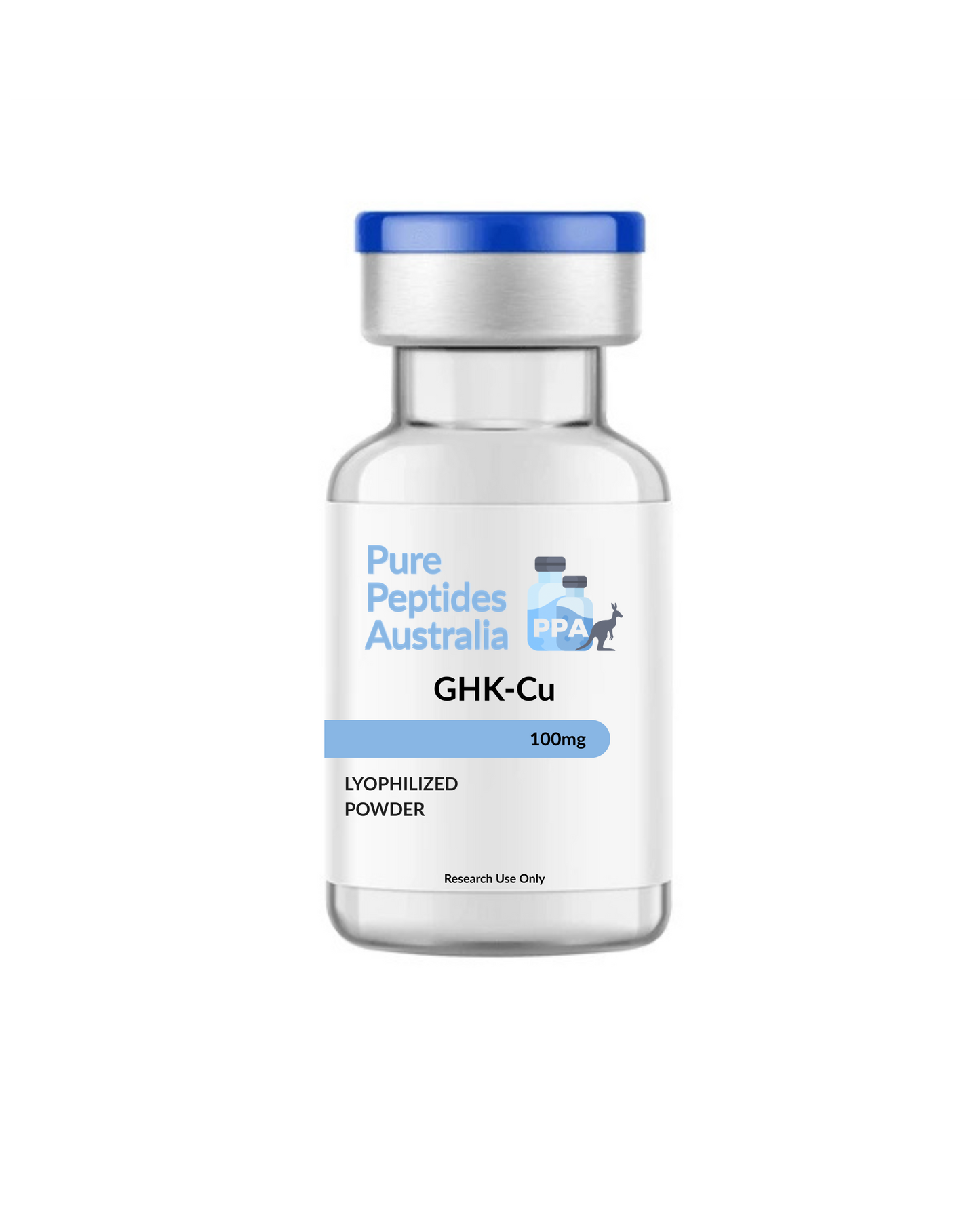
Pure Peptides Australia holds GHK-Cu in Sydney stock in 50mg and 100mg vials plus a Starter Kit with water and syringes, each lyophilised and Janoshik tested before listing. Orders confirmed before 12pm AEST on a business day are dispatched the same day with tracked delivery Australia-wide.
- GHK-Cu
- GHK Cu
- GHKCu
- Copper peptide
- Copper tripeptide-1
- GHK copper
- Prezatide copper
- GHKu
Why it is blue, and why that matters
GHK binds copper(II) through the imidazole ring of its histidine, the free amine of its glycine and a backbone amide, forming a square-planar complex with an affinity close to albumin's. That complex is what gives the reconstituted solution its violet-blue colour, and it is also the point of the molecule: GHK can accept copper from albumin and hand it to cells, feeding copper-dependent enzymes such as lysyl oxidase, which cross-links collagen, and superoxide dismutase, which handles oxidative stress. Copper-free GHK does not reproduce all of those effects, which is why the copper form is the one studied.
Key research areas
Collagen and elastin synthesis
In cultured human fibroblasts GHK-Cu increases production of type I collagen, elastin, decorin and glycosaminoglycans, the matrix components that thin with age (Pickart and Margolina, International Journal of Molecular Sciences 2018).
Skin remodelling
Animal and ex-vivo skin models examine dermal thickness, elasticity and repair of photo-damaged tissue, with matrix metalloproteinases and their inhibitors both modulated.
Wound repair
Rodent wound models study closure rate, granulation tissue and angiogenesis, combining copper delivery with recruitment of fibroblasts, immune cells and endothelial cells into the wound bed.
Hair follicle biology
Dermal-papilla cultures and animal models examine follicle size and the transition of follicles into the growth phase, with follicle blood supply proposed as the mechanism.
Gene expression
Broad Institute connectivity-map analysis reported GHK-Cu resets expression of around 4,000 human genes, including those governing tissue repair, DNA repair and antioxidant defence (Pickart et al., BioMed Research International 2015).
Anti-inflammatory and antioxidant
Cell models report reduced TNF-alpha and IL-6 secretion, suppressed NF-kB signalling and limited iron release from ferritin, cutting the free-iron pool that drives oxidative damage.
How GHK-Cu compares
GHK-Cu is a matrix and signalling peptide, not a growth factor. Against BPC-157, which works through nitric-oxide and VEGFR2 pathways in tendon and gut models, GHK-Cu is studied in the later remodelling phase of repair, when collagen is laid down, which is why the two are combined in the GLOW and KLOW blends rather than used interchangeably. It is cleared quickly from circulation, so research models tend to use local or repeated administration. AHK-Cu is a related copper tripeptide used mainly in hair research; the two are not the same compound.
Specifications
| Compound | GHK-Cu (copper tripeptide-1) |
| Also known as | GHK Cu, GHKCu, GHK/Cu, copper peptide, copper tripeptide-1, GHK copper, prezatide copper; misspellings ghku, ghkco, chk cu, gkcu |
| CAS number | 89030-95-5 (copper complex); 49557-75-7 (free GHK) |
| Molecular formula | C14H22CuN6O4 |
| Molecular weight | ~401.9 g/mol (copper complex); free GHK 340.4 |
| Sequence | Gly-His-Lys, copper(II) bound |
| Category | Dermal research |
| Purity | ≥99% HPLC, batch COA supplied (Janoshik Analytical) |
| Form | Lyophilised powder in a sealed sterile vial; dissolves blue |
| Vial sizes | 50mg, 100mg, Starter Kit (50mg with water and syringes) |
| Storage (lyophilised) | -20°C long term, 2 to 8°C short term, protect from light |
| Storage (reconstituted) | 2 to 8°C, use within 28 days |
| Reconstitution | Bacteriostatic water |
Sizes and pricing in Australia
The 100mg is a third cheaper per milligram
| Option | Price | Per mg | Suits |
| 50mg | $89.99 | $1.80 | First order, single short protocol |
| 100mg | $109.99 | $1.10 | Longer or repeated work, topical formulation research |
| Starter Kit | $119.99 | $2.40 | 50mg with bacteriostatic water and syringes, nothing else to source |
Because GHK-Cu is studied at higher masses than most peptides, the 100mg is the size most researchers move to after a first order. The 50mg is also the copper-peptide component of the GLOW Starter Bundle.
Reconstitution
Let the vial reach room temperature. Wipe the stopper, add bacteriostatic water slowly down the inside wall and swirl gently until fully dissolved, never shake. The solution turns violet-blue as the copper complex dissolves; that is normal. Refrigerate at 2 to 8°C and use within 28 days.
| Vial | Water added | Concentration | Per 10 units on a U-100 syringe |
| 50mg | 2.5mL | 20mg/mL | 2mg |
| 50mg | 5mL | 10mg/mL | 1mg |
| 100mg | 5mL | 20mg/mL | 2mg |
| 100mg | 10mL | 10mg/mL | 1mg |
The reconstitution calculator runs the maths for any target. A 100mg vial takes the full 10mL water vial at the lower concentration.
Quality and COA verification
Every batch is tested by Janoshik Analytical: HPLC purity, mass-spec identity of the copper tripeptide, heavy metals and endotoxin. The batch number on the label matches the certificate.
Sydney stock, tracked delivery
No international transit or customs queue. Orders cleared before 12pm AEST leave the same business day; Express Post reaches most metro addresses in one to three business days.
Frequently bought together
$149.99. GHK-Cu with BPC-157, TB-500 and KPV in one vial.
$219.99. GHK-Cu 50mg with the BPC-157/TB-500 blend and supplies.
From $69.99. The repair peptide most often run alongside GHK-Cu.
$29.99. GHK-Cu needs more water than most vials.
GHK-Cu Australia FAQ
What is GHKCu?
GHKCu is GHK-Cu written without the hyphen. G, H and K are the single-letter codes for glycine, histidine and lysine, and Cu is copper. Same compound however it is spelled: a copper-bound tripeptide supplied here as a lyophilised research vial.
What is GHK-Cu?
A copper complex of the tripeptide glycyl-L-histidyl-L-lysine that occurs naturally in plasma, saliva and urine. It is studied for collagen synthesis, skin remodelling, wound repair, hair follicle biology and broad gene-expression effects, and its plasma levels fall sharply with age.
What is GHK-Cu also known as?
GHK Cu, GHKCu, GHK/Cu, copper peptide, copper tripeptide-1 (its cosmetic ingredient name), GHK copper and prezatide copper. Common misspellings are ghku, ghkco, chk cu and gkcu.
How does GHK-Cu work?
It carries copper to cells and copper-dependent enzymes such as lysyl oxidase, stimulates fibroblasts to produce collagen, elastin and glycosaminoglycans, modulates matrix metalloproteinases and damps inflammatory signalling through NF-kB. Gene-expression profiling shows it resets a large number of repair and antioxidant genes.
What does the research show?
Increased collagen and elastin in fibroblast cultures, faster closure and better granulation tissue in rodent wound models, improved dermal thickness and elasticity in skin models, and follicle growth in dermal-papilla cultures. Gene-array work reports effects on around 4,000 human genes. All preclinical.
Why is GHK-Cu blue?
The copper ion bound inside the peptide complex. A vivid violet-blue solution on reconstitution is the sign of an intact copper tripeptide, not degradation.
GHK-Cu vs BPC-157: what is the difference?
BPC-157 is studied in the early repair phase through nitric-oxide and growth-factor pathways in tendon, muscle and gut. GHK-Cu is studied in the remodelling phase, when collagen is deposited. They are combined in the GLOW and KLOW blends rather than swapped for one another.
Can I buy GHK-Cu at Chemist Warehouse in Australia?
Only as a cosmetic serum with copper peptide at around 1% in a topical formula. Research-grade lyophilised GHK-Cu is a different product, not a registered medicine, and is not sold by any Australian pharmacy.
How do you reconstitute GHK-Cu?
Bring the vial to room temperature, add bacteriostatic water slowly down the inside wall, swirl gently until dissolved, never shake, refrigerate at 2 to 8°C and use within 28 days. 50mg in 2.5mL gives 20mg/mL, so 10 units carries 2mg.
How should GHK-Cu be stored?
Lyophilised at -20°C long term or 2 to 8°C short term, away from light. The copper complex is stable as a dry powder. Reconstituted at 2 to 8°C and used within 28 days.
50mg or 100mg?
50mg for a first order or a single short protocol. 100mg for longer or repeated work and for topical formulation research, where larger amounts are dissolved; it is a third cheaper per mg. The Starter Kit is the 50mg with water and syringes included.
Is GHK-Cu available in Australia?
As a research compound, yes: Pure Peptides Australia holds 50mg and 100mg vials in Sydney with same-day dispatch. As a medicine, no. As of October 2026 it is not a TGA-listed therapeutic good.
Where can I buy GHK-Cu in Australia?
From this page. Choose a size, check out with card, PayID, Osko or bank transfer, and the vial leaves Sydney the same business day when payment clears before 12pm AEST, tracked to any Australian address.
What does GHK-Cu cost in Australia?
$89.99 for 50mg ($1.80 per mg), $109.99 for 100mg ($1.10 per mg), or $119.99 for the Starter Kit. No surcharge on PayID, Osko or bank transfer.
Is GHK-Cu legal in Australia?
Pure Peptides Australia supplies it strictly for lawful in-vitro laboratory research. It is not approved by the TGA for human or veterinary use and is not sold as a medicine, cosmetic or supplement. Purchasers are responsible for ensuring their use complies with applicable laws.