Pure Peptides Australia
BPC-157 – Research Peptide | Pure Peptides Australia
BPC-157 – Research Peptide | Pure Peptides Australia
Not for human, veterinary, diagnostic, or therapeutic use.
Tissue repair research compound
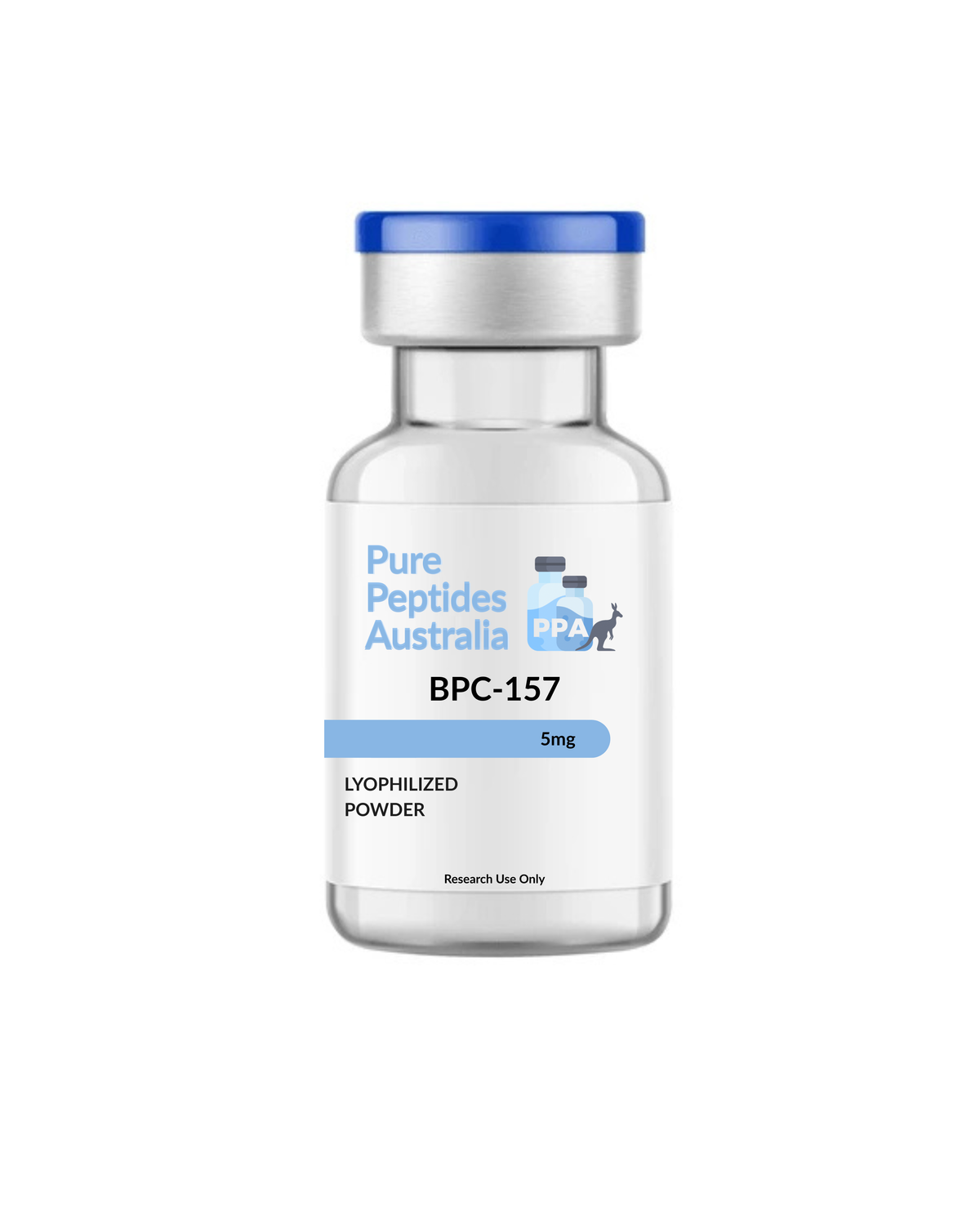
BPC-157 (5mg and 10mg): Pentadecapeptide for Tendon, Muscle and Gut Repair Research
BPC-157 is a synthetic chain of fifteen amino acids, Gly-Glu-Pro-Pro-Pro-Gly-Lys-Pro-Ala-Asp-Asp-Ala-Gly-Leu-Val, matching a partial sequence of a protective protein first isolated from human gastric juice by a Zagreb research group in the early 1990s. The name stands for Body Protection Compound. It is one of the most extensively studied repair peptides in preclinical science because it shows activity across musculoskeletal, gastrointestinal, vascular and neurological models rather than in one system. Searched as bpc 157 australia, bpc157, bcp 157, bp 157, the healing peptide and body protection compound.
Pure Peptides Australia holds BPC-157 in Sydney stock in 5mg and 10mg vials, Janoshik tested before listing. Orders confirmed before 12pm AEST on a business day are dispatched the same day with tracked delivery Australia-wide.
- BPC 157
- BPC157
- BCP-157
- BP157
- PL 14736
- Body Protection Compound
- Pentadecapeptide
Why it stands out
Two things separate BPC-157 from other repair peptides. Breadth: the same molecule has been studied in tendon, ligament, muscle, bone, gut, liver, heart, nerve and vessel models over three decades. And stability: it stays intact in human gastric juice for more than 24 hours, unusual for a linear peptide, which is why both injectable and oral formats appear in the literature. It works through converging pathways rather than one receptor, chiefly nitric-oxide signalling, VEGFR2-driven angiogenesis and the FAK-paxillin pathway in fibroblasts.
Key research areas
Tendon and ligament
Achilles transection, MCL injury and tendon-to-bone models; increased fibroblast outgrowth via FAK-paxillin (Chang et al., Journal of Applied Physiology 2011).
Muscle
Crush, transection and corticosteroid-impaired healing models measuring functional recovery, fibre regeneration and reduced fibrosis.
Gastrointestinal
The original use: gastric and duodenal ulcer, fistula, anastomosis, NSAID lesion and colitis models, with an early-phase clinical programme in inflammatory bowel disease (Sikiric et al., Current Pharmaceutical Design 2018).
Angiogenesis and blood flow
New vessel formation and collateral recruitment after vessel occlusion, through eNOS and VEGFR2 activation in endothelial cells.
Nerve repair
Peripheral nerve transection, traumatic brain injury and spinal-cord compression models, plus interactions with dopamine and serotonin systems.
Organ cytoprotection
Liver, heart, pancreas and kidney injury models framed around a gut-organ protective axis, with NO-system and prostaglandin pathways proposed.
How BPC-157 compares
TB-500 works by binding actin to move cells into a wound; BPC-157 works by signalling growth factors and nitric oxide at the site. That is why the two are studied together and sold pre-mixed as the BPC-157 + TB-500 blend. GHK-Cu covers the later collagen-remodelling phase, and the three together are the GLOW combination. Human pharmacokinetic data are limited, so BPC-157's half-life is not reliably established.
Specifications
| Compound | BPC-157 (Body Protection Compound-157) |
| Also known as | BPC 157, BPC157, pentadecapeptide BPC 157, PL 14736, BCP-157, BCP157, BP157, PBC 157, BOC 157, peptide 157, healing peptide |
| CAS number | 137525-51-0 |
| Molecular formula | C62H98N16O22 |
| Molecular weight | 1419.6 g/mol |
| Sequence | GEPPPGKPADDAGLV (15 amino acids) |
| Category | Tissue repair research |
| Purity | ≥99% HPLC, batch COA supplied (Janoshik Analytical) |
| Form | Lyophilised powder in a sealed sterile vial |
| Vial sizes | 5mg, 10mg |
| Storage (lyophilised) | -20°C long term, 2 to 8°C short term, protect from light |
| Storage (reconstituted) | 2 to 8°C, use within 28 days |
| Reconstitution | Bacteriostatic water |
Sizes and pricing in Australia
5mg for a first order, 10mg for a full protocol
| Vial | Price | Per mg | Yields |
| 5mg | $69.99 | $14.00 | Twenty 250mcg draws |
| 10mg | $99.99 | $10.00 | Forty 250mcg draws |
BPC-157 is studied in microgram amounts, so a 10mg vial covers a 28-day protocol comfortably. The BPC-157 + TB-500 blend supplies 5mg of each in one 10mg vial for $109.99.
Reconstitution
Wipe the stopper, add bacteriostatic water slowly down the inside wall, swirl gently until clear, never shake, since agitation can fragment the peptide. Refrigerate at 2 to 8°C and use within 28 days.
| Vial | Water added | Concentration | 250mcg on a U-100 syringe |
| 5mg | 1mL | 5mg/mL | 5 units |
| 10mg | 2mL | 5mg/mL | 5 units |
| 10mg | 1mL | 10mg/mL | 2.5 units |
The reconstitution calculator runs the maths for any target.
Quality and COA verification
Every batch is tested by Janoshik Analytical: HPLC purity, mass-spec identity against 1420 g/mol, heavy metals and endotoxin. The batch number on the label matches the certificate.
Sydney stock, tracked delivery
No international transit or customs queue. Orders cleared before 12pm AEST leave the same business day; Express Post reaches most metro addresses in one to three business days.
Frequently bought together
$99.99. The peptide most often studied alongside BPC-157.
From $109.99. Both pre-mixed in one vial.
10mL $29.99, 3mL $14.99. Required for reconstitution.
$79.99. For gut inflammation models alongside.
BPC-157 Australia FAQ
What is BPC?
The everyday shorthand for BPC-157, where the letters stand for Body Protection Compound and 157 identifies the fifteen-amino-acid fragment. BPC, BPC 157 and BPC157 all mean this compound.
What is BPC-157?
A synthetic pentadecapeptide with the sequence GEPPPGKPADDAGLV, derived from a protein in human gastric juice and studied for three decades in tendon, ligament, muscle, gut and nerve repair models. It is a cytoprotective research compound, not a hormone, and it stays intact in gastric juice for more than 24 hours.
What is BPC-157 also known as?
BPC 157, BPC157, pentadecapeptide BPC 157, PL 14736, and the misspellings bcp 157, bp 157, pbc 157 and boc 157. In research communities it is called the healing peptide.
How does BPC-157 work?
Through several converging pathways rather than one receptor: VEGFR2 and nitric-oxide signalling in endothelial cells, the FAK-paxillin pathway in fibroblasts, and early growth response genes that regulate cytokines during repair.
What does the research show?
Faster structural and functional recovery in rodent tendon, ligament, muscle and nerve models, gut-lining protection against ulceration and NSAID damage, improved fistula and anastomosis healing, and blood-flow recovery after vessel occlusion. Human data are limited to early-phase IBD studies.
BPC-157 or TB-500?
BPC-157 for localised repair and the gut; TB-500 for cell migration and systemic effects. Most protocols use both, which is why the pre-mixed blend exists.
Can I buy BPC-157 at Chemist Warehouse in Australia?
No. There is no BPC-157 product registered on the ARTG, so no Australian pharmacy stocks it. Products marketed as BPC-157 capsules or tablets through retail channels are not this research-grade lyophilised compound.
How do you reconstitute BPC-157?
Add bacteriostatic water slowly down the inside wall, swirl gently until clear, never shake, refrigerate at 2 to 8°C and use within 28 days. 2mL into the 10mg gives 5mg/mL, so 250mcg is 5 units on a U-100 syringe.
How should BPC-157 be stored?
Lyophilised at -20°C long term or 2 to 8°C short term, away from light. Reconstituted at 2 to 8°C and used within 28 days; do not freeze the solution.
Is BPC-157 available in Australia?
As a research compound, yes: Pure Peptides Australia holds 5mg and 10mg vials in Sydney with same-day dispatch. As a medicine, no. As of October 2026 it is not TGA approved.
Where can I buy BPC-157 in Australia?
From this page. Choose a size, check out with card, PayID, Osko or bank transfer, and the vial leaves Sydney the same business day when payment clears before 12pm AEST, tracked to any Australian address.
What does BPC-157 cost in Australia?
$69.99 for 5mg ($14.00 per mg) or $99.99 for 10mg ($10.00 per mg). No surcharge on PayID, Osko or bank transfer.
Is BPC-157 legal in Australia?
Pure Peptides Australia supplies it strictly for lawful in-vitro laboratory research. It is not approved by the TGA for human or veterinary use and is not sold as a medicine, supplement or therapeutic good. Purchasers are responsible for ensuring their use complies with applicable laws.