Pure Peptides Australia
Retatrutide – Research Peptide | Pure Peptides Australia
Retatrutide – Research Peptide | Pure Peptides Australia
Not for human, veterinary, diagnostic, or therapeutic use.
Metabolic research compound
Retatrutide (5mg to 60mg): Triple GLP-1, GIP and Glucagon Receptor Agonist
Retatrutide is the most searched research peptide in Australia and the compound Pure Peptides Australia is best known for. It is a 39-amino-acid synthetic peptide developed by Eli Lilly under the code LY3437943, engineered as a single molecule that activates three receptors at once: GLP-1, GIP and glucagon. Researchers shorten it to Reta or the reta peptide.
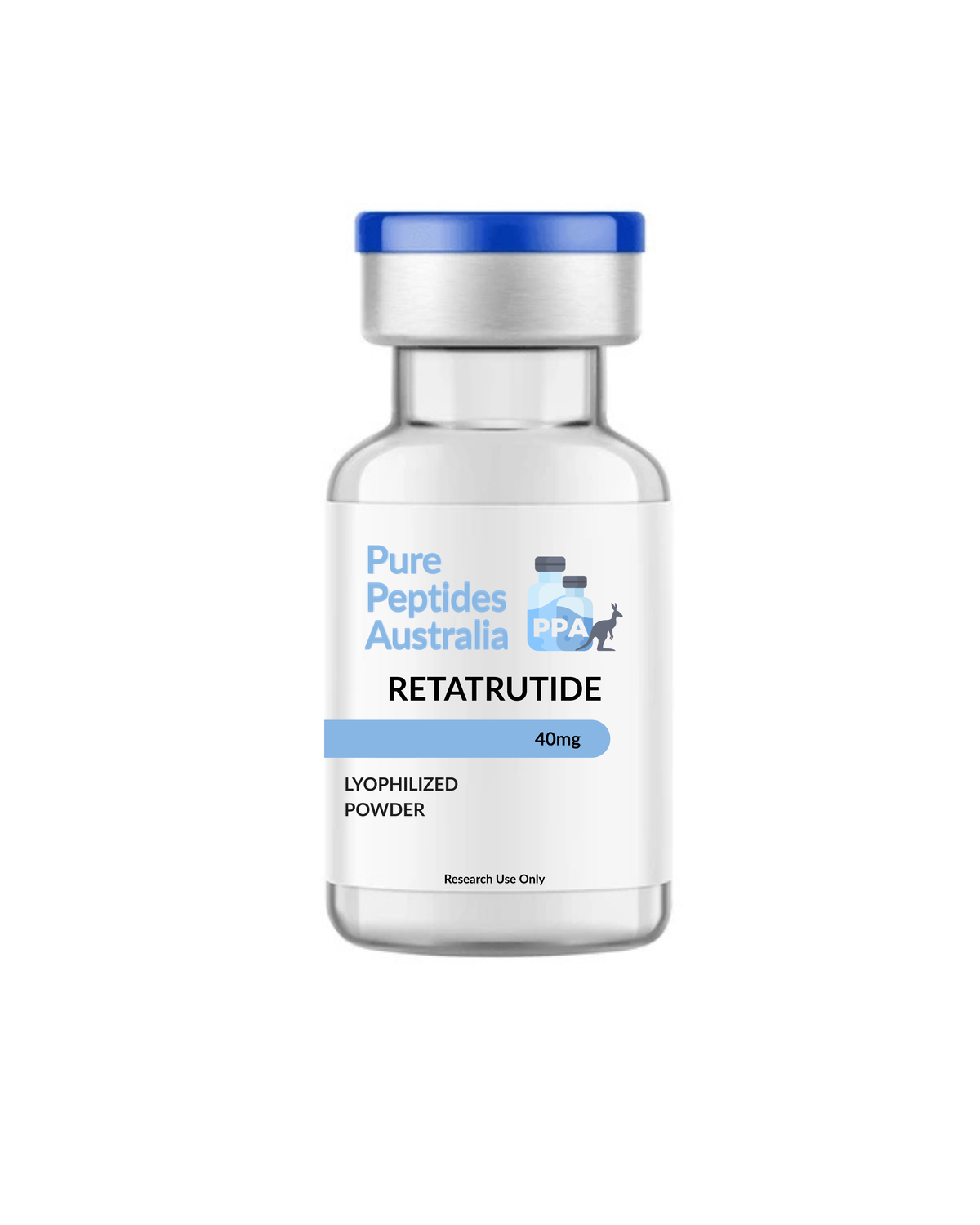
Held in Australian stock in six vial sizes, each lyophilised in a sealed sterile vial and tested by Janoshik Analytical before listing. Orders confirmed before 12pm AEST on a business day are dispatched the same day from Sydney with tracked delivery to every state, including Melbourne, Brisbane, Perth and Adelaide.
- Reta
- Reta peptide
- LY3437943
- Triple agonist
- GGG tri-agonist
- Retatrutide vial (not pen)
- Retarutide
- Retatritide
- Reda peptide
Why it is different
Semaglutide acts on GLP-1 alone. Tirzepatide adds GIP. Retatrutide adds glucagon on top of both, which is why the published trials report larger body-weight reductions than any dual agonist and why it is called a next-generation compound.
Key research areas
Body-weight regulation
Phase 2 (Jastreboff et al., NEJM 2023, n=338, 48 weeks): 8.7%, 17.1%, 22.8% and 24.2% at 1, 4, 8 and 12mg weekly vs 2.1% placebo. TRIUMPH-1 (n=2,339, 80 weeks, May 2026): 19.0%, 25.9% and 28.3% at 4, 9 and 12mg; 30.3% at 104 weeks.
Glycaemic control
TRIUMPH-2 (n=1,152, type 2 diabetes): HbA1c down 1.4 to 1.6 points alongside 12.7% to 20.8% weight reduction, reflecting glucose-dependent insulin release through the GIP and GLP-1 receptors.
Hepatic fat
A Phase 2a substudy in fatty liver measured liver-fat change, the endpoint most directly tied to the glucagon receptor's role in hepatic lipid oxidation. Larger liver trials are in progress.
Cardiovascular models
TRIUMPH-3 (n=1,949, obesity with established cardiovascular disease): 22.6% weight reduction at 12mg. A dedicated cardiovascular outcomes trial is under way.
Energy expenditure
Glucagon receptor activation is studied for increased resting energy expenditure, the proposed reason the triple agonist outperforms dual agonists at matched appetite suppression.
Receptor pharmacology
Most potent at GIP, then GLP-1, then glucagon. The C20 fatty diacid chain binds serum albumin for a plasma half-life of roughly six days.
How Retatrutide works
Retatrutide is built on a GIP backbone with substitutions that add GLP-1 and glucagon receptor activity, then lipidated with a C20 fatty diacid so it circulates bound to albumin. Steady state is reached over four to five weeks, which is why every published protocol uses once-weekly administration with a stepped increase over several months. GLP-1 activity slows gastric emptying and reduces food intake; GIP activity is studied for additive weight and insulin-sensitivity effects and for blunting nausea; glucagon activity raises energy expenditure and hepatic fat clearance.
A distinctive adverse event in TRIUMPH was dysesthesia (altered skin sensation) at 4.5% to 7.3% versus under 1.5% on placebo, attributed to the glucagon arm. Against Tirzepatide, Retatrutide has the shorter research record but the larger reported effect: 28.3% at 80 weeks versus roughly 21% at 72 weeks, in different trials. Both are stocked here.
Specifications
| Compound | Retatrutide (LY3437943) |
| Also known as | Reta, reta peptide, retatrutide peptide, GGG tri-agonist, triple agonist; misspellings retarutide, retatritide, reda |
| CAS number | 2381089-83-2 |
| Molecular formula | C221H342N46O68 |
| Molecular weight | 4731.3 g/mol |
| Structure | 39 amino acids on a GIP backbone, C20 fatty diacid lipidation |
| Half-life (published) | Approximately 6 days |
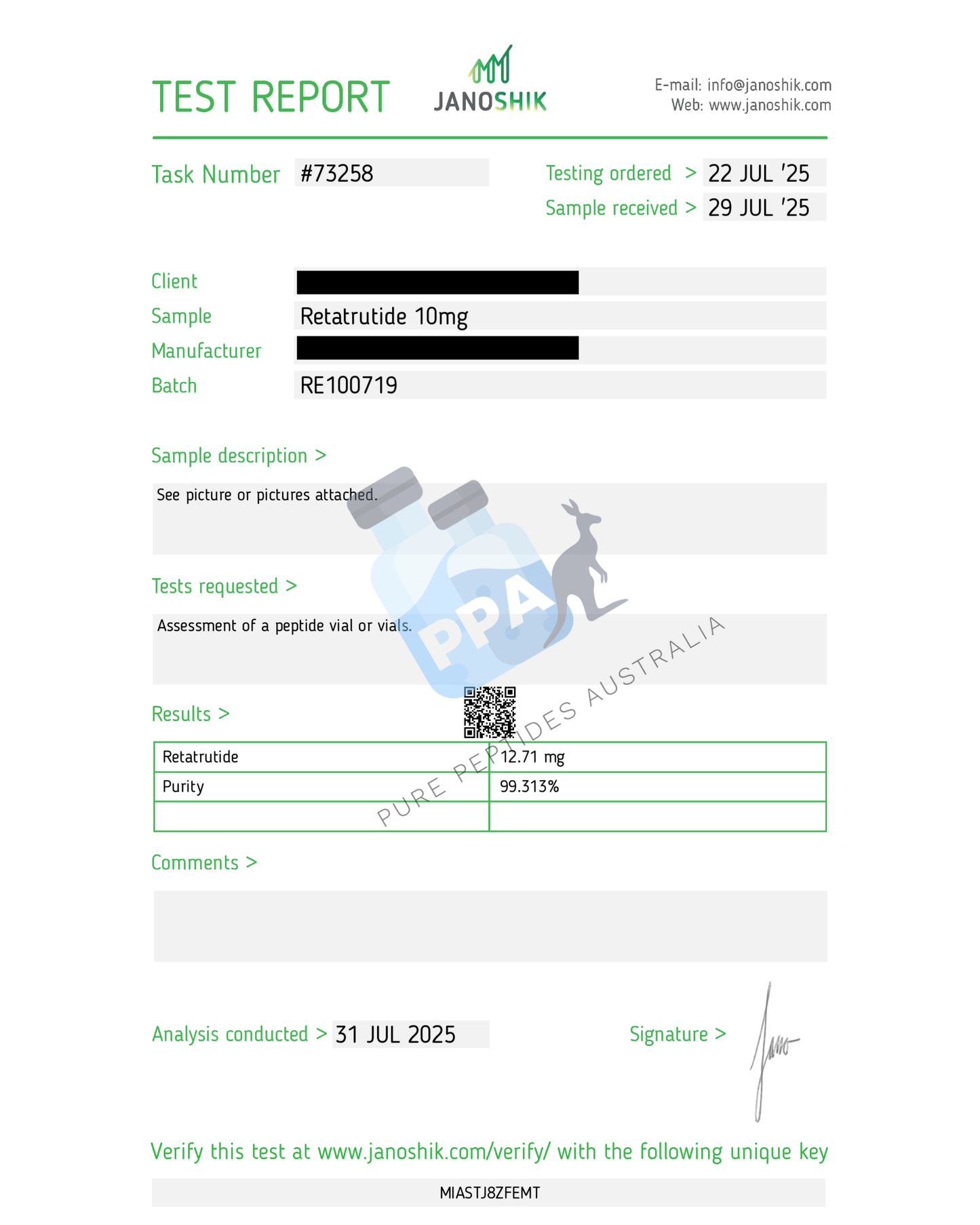
| Purity | ≥99% HPLC, batch COA supplied (Janoshik Analytical) |
| Form | Lyophilised powder in a sealed sterile vial (research vial, not a pen) |
| Vial sizes | 5mg, 10mg, 20mg, 30mg, 40mg, 60mg |
| Storage (lyophilised) | -20°C long term, 2 to 8°C short term, protect from light, avoid freeze-thaw |
| Storage (reconstituted) | 2 to 8°C, use within 28 days |
| Reconstitution | Bacteriostatic water |
Sizes and pricing in Australia
Price per milligram falls as the vial gets larger
The vial, stopper, lyophilisation run and Janoshik test cost the same whatever the fill weight. The 5mg suits a first order or a batch check, the 30mg is the size most researchers settle on for a sustained single arm, and the 60mg is the cheapest per mg for anyone who can freeze aliquots past the 28-day window.
| Vial | Price | Per mg | Yields |
| 5mg | $99.99 | $20.00 | Five 1mg aliquots |
| 10mg | $159.99 | $16.00 | Ten 1mg or five 2mg |
| 20mg | $259.99 | $13.00 | Ten 2mg or five 4mg |
| 30mg | $359.99 | $12.00 | Fifteen 2mg or seven 4mg |
| 40mg | $449.99 | $11.25 | Ten 4mg or four 10mg |
| 60mg | $599.99 | $10.00 | Fifteen 4mg or five 12mg |
The Retatrutide Starter Kit ($189.99) pairs one 10mg vial with bacteriostatic water, syringes and swabs. The Retatrutide Premium Kit ($329.99) supplies two 10mg vials with 10mL of water and ten syringes.
Reconstitution
Retatrutide is a freeze-dried cake and does nothing until it is in solution. Wipe the stopper, draw the chosen volume of bacteriostatic water and run it slowly down the inside wall of the vial rather than onto the powder. Swirl until clear, never shake, then refrigerate at 2 to 8°C and use within 28 days. The water volume sets the concentration, and the concentration sets the syringe units per milligram.
| Vial | Water added | Concentration | 1mg on a U-100 syringe |
| 5mg | 1mL | 5mg/mL | 20 units |
| 10mg | 2mL | 5mg/mL | 20 units |
| 20mg | 2mL | 10mg/mL | 10 units |
| 30mg | 3mL | 10mg/mL | 10 units |
| 40mg | 2mL | 20mg/mL | 5 units |
| 60mg | 3mL | 20mg/mL | 5 units |
The free reconstitution calculator runs the maths for any vial and any target amount.
Quality and COA verification
Every batch is tested by Janoshik Analytical: HPLC for purity, mass spectrometry for identity against the expected 4731 g/mol, plus heavy-metal and endotoxin panels. The batch number on the label matches the certificate, so the result for the exact vial you receive can be checked.
Sydney stock, tracked delivery
Vials never sit in international transit or a customs queue. Orders cleared before 12pm AEST leave the same business day; Express Post reaches most metro addresses in one to three business days.
Frequently bought together
10mL $29.99, 3mL $14.99. Required for reconstitution.
$189.99. One 10mg vial plus water, syringes and swabs.
$119.99. The dual-agonist comparison arm.
Mitochondrial metabolic research alongside.
Retatrutide Australia FAQ
What is Reta?
Reta is the shorthand for Retatrutide, a triple GLP-1, GIP and glucagon receptor agonist research peptide developed by Eli Lilly under the code LY3437943. It is the most searched research peptide in Australia and the one with the largest body-weight reductions reported in published trials.
What is Retatrutide?
A 39-amino-acid synthetic peptide built on a GIP backbone and lipidated with a C20 fatty diacid, giving it a six-day half-life. It activates the GLP-1, GIP and glucagon receptors together and is studied in obesity, type 2 diabetes, fatty liver and cardiovascular models.
What is Retatrutide also known as?
Reta, reta peptide, retatrutide peptide, LY3437943, GGG tri-agonist and triple agonist. Common misspellings are retarutide, retatritide and reda peptide.
How does Retatrutide work?
GLP-1 activity reduces appetite and slows gastric emptying, GIP activity is studied for additive weight and insulin-sensitivity effects, and glucagon activity raises energy expenditure and hepatic fat clearance. Acting on all three at once is what separates it from semaglutide (one receptor) and Tirzepatide (two).
What does the research show?
Phase 2 reported up to 24.2% weight reduction at 48 weeks. Phase 3 TRIUMPH-1 reported 28.3% at 80 weeks and 30.3% at 104 weeks, with just under half of the 12mg arm losing 30% or more of body weight. TRIUMPH-2 and TRIUMPH-3 extended those results to diabetes and cardiovascular cohorts. All figures describe the sponsor's controlled trials of a pharmaceutical-grade product.
Can I buy Retatrutide at Chemist Warehouse in Australia?
No. Retatrutide is not a registered medicine anywhere and is not stocked by Chemist Warehouse, Priceline or any pharmacy. Anything advertised as retatrutide pens or tablets at a pharmacy is not this compound. It is available in Australia only as a research-grade lyophilised vial.
Is there a Retatrutide pen in Australia?
No. Retatrutide has not been approved anywhere, so no pharmaceutical pen exists in Australia or overseas. Anything sold as a retatrutide pen is either a counterfeit of a product that does not exist or a research vial repackaged. Research-grade Retatrutide is supplied as a lyophilised powder in a sealed vial that is reconstituted with bacteriostatic water, which is what every published trial and every legitimate research supplier uses.
Can Australian compounding pharmacies supply Retatrutide?
Compounding pharmacies prepare medicines for an individual patient on a prescription, and Retatrutide is an unapproved investigational compound rather than a registered medicine, so it is not a standard compounding item. Pure Peptides Australia supplies the research-grade compound for laboratory use only.
How do you reconstitute Retatrutide?
Add bacteriostatic water slowly down the inside wall of the vial, swirl gently until clear, never shake, refrigerate at 2 to 8°C and use within 28 days. A 10mg vial with 2mL gives 5mg/mL, so 1mg is 20 units on a U-100 syringe. The reconstitution table above covers every size.
How should Retatrutide be stored?
Lyophilised vials keep at -20°C long term or 2 to 8°C short term, away from light, without repeated freeze-thaw. Reconstituted solution stays refrigerated and is used within 28 days; single-use aliquots can be frozen to extend that.
Is Retatrutide available in Australia?
As a research compound, yes: Pure Peptides Australia holds all six sizes in Sydney with same-day dispatch. As a medicine, no. As of October 2026 it is not TGA approved, not on the ARTG, and Lilly has not yet filed for approval in any country; an FDA submission is planned for early 2027.
Where can I buy Retatrutide in Australia?
Directly from this page. Choose a size, check out with card, PayID, Osko or bank transfer, and the vial leaves Sydney the same business day when payment clears before 12pm AEST, tracked to any Australian address. Melbourne, Brisbane, Perth and Adelaide metro addresses typically receive Express Post in one to three business days.
What does Retatrutide cost in Australia?
Between $10.00 and $20.00 per milligram depending on vial size: $99.99 for 5mg through $599.99 for 60mg. The Starter Kit is $189.99 and the Premium Kit $329.99. There is no surcharge on PayID, Osko or bank transfer.
Retatrutide vs Tirzepatide: what is the difference?
Tirzepatide is a dual GLP-1 and GIP agonist with a longer research record. Retatrutide adds the glucagon receptor and reports the larger effect: 28.3% at 80 weeks versus roughly 21% for Tirzepatide at 72 weeks, in different trials. Both are stocked here.
Which vial size should I choose?
5mg or the Starter Kit for a first order, 10mg or 20mg for a single short protocol, 30mg for a sustained arm at $12.00 per mg, 60mg for the lowest per-mg cost if aliquots can be frozen beyond 28 days.
Is Retatrutide legal in Australia?
Pure Peptides Australia supplies Retatrutide strictly for lawful in-vitro laboratory research. It is not approved by the TGA for human or veterinary use and is not sold as a medicine, supplement or therapeutic good. Purchasers are responsible for ensuring their use complies with applicable laws.